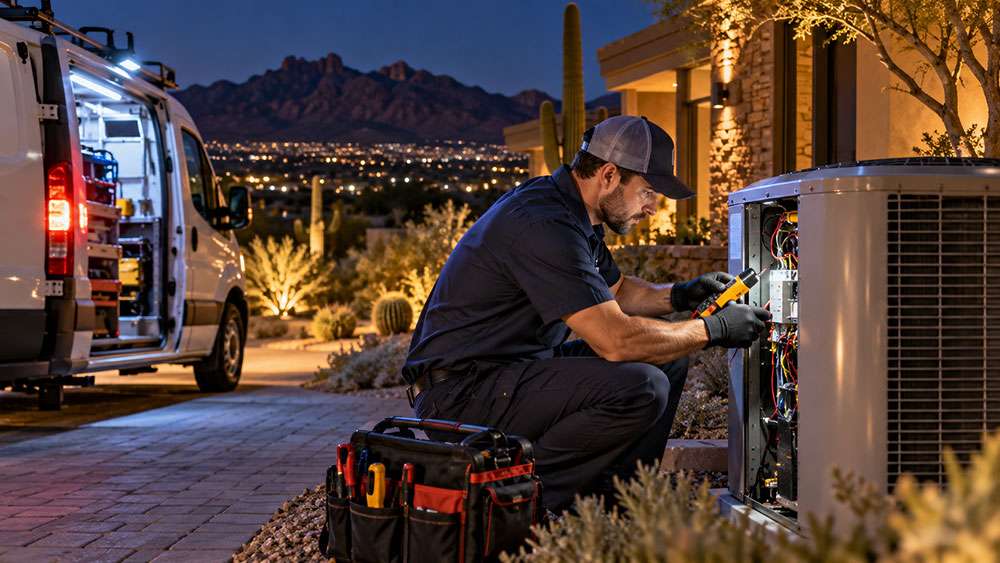
An air conditioner that suddenly stops working at night can quickly turn into a serious problem in Paradise Valley, especially during Arizona’s warmer months. If your AC stopped working at night in Paradise Valley, AZ, a few safe checks may help identify a simple issue. However, electrical smells, repeated breaker trips, complete cooling failure during extreme heat, or other serious symptoms should be handled by an HVAC professional.
Entity Refrigeration provides residential and commercial HVAC support throughout Paradise Valley and surrounding Arizona communities. If your cooling system fails after normal business hours, knowing what to check—and when to stop troubleshooting—can help protect both your comfort and your equipment.
Why Nighttime AC Failures Need Quick Attention in Paradise Valley
Paradise Valley homes rely heavily on air conditioning for much of the year. Even after sunset, outdoor temperatures can remain high enough for indoor spaces to become uncomfortable when cooling stops.
An AC failure may also affect:
- Children and older adults
- Pets
- People with heat-sensitive medical conditions
- Bedrooms on upper floors
- Home offices and electronics
- Restaurants and commercial properties
- Temperature-sensitive business operations
Arizona health officials recommend staying in air-conditioned spaces during extreme heat whenever possible and paying particular attention to people who are more vulnerable to heat-related illness.
If your home becomes dangerously hot or someone begins showing signs of heat-related illness, cooling and personal safety should take priority over troubleshooting the HVAC system.
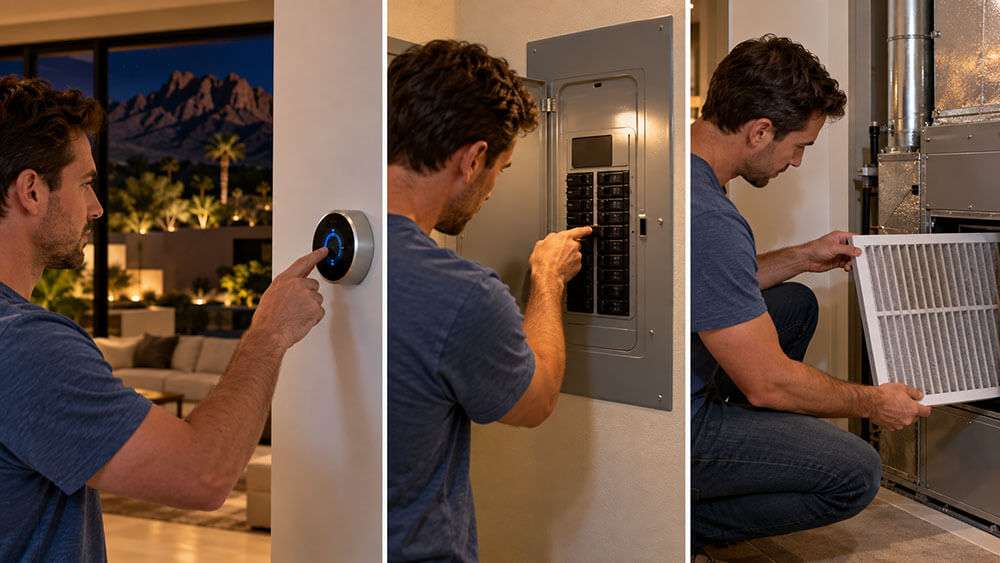
Step 1: Check Your Thermostat
The thermostat is the simplest place to start.
Make sure:
- The thermostat display is on.
- The system is set to Cool.
- The selected temperature is lower than the current indoor temperature.
- The fan setting is appropriate.
- The thermostat has working batteries if it uses them.
Sometimes thermostats are accidentally switched to Heat, Fan, or Off. Smart thermostats can also lose power or connectivity.
Lowering the thermostat dramatically will not make a properly functioning AC system cool faster. Set it to a reasonable cooling temperature and see whether the system starts normally.
If the thermostat appears to be working but the outdoor unit and indoor blower remain off, continue with the next checks.
Step 2: Check the HVAC Circuit Breaker
A tripped breaker can stop an air conditioner from operating.
Go to the electrical panel and look for breakers labeled:
- AC
- Air Conditioner
- HVAC
- Furnace
- Air Handler
- Condenser
If a breaker is clearly tripped, it may be reset once if you can safely do so.
What if the breaker trips again?
Do not continue resetting it.
A breaker that repeatedly trips may indicate:
- Electrical component failure
- Compressor problems
- Motor problems
- Damaged wiring
- Short circuit
- Other equipment faults
Repeatedly resetting a breaker without finding the cause can create additional risk.
If the breaker trips again, turn the system off and contact a qualified HVAC technician.
Step 3: Inspect the Air Filter
A severely dirty filter can restrict airflow through your HVAC system.
Poor airflow may contribute to:
- Weak cooling
- Longer run times
- Frozen evaporator coils
- Higher energy use
- System strain
- Premature component wear
ENERGY STAR recommends regularly inspecting HVAC filters and replacing or cleaning them when dirty.
If the filter is easily accessible, check it. If it is heavily clogged, replace it with the correct size and type recommended for your system.
Do not remove the filter permanently and operate the AC without one.
For additional maintenance guidance, see the ENERGY STAR heating and cooling maintenance checklist.
Step 4: Check Whether Air Is Coming From the Vents
Turn the system to cooling mode and carefully check a few supply vents.
There are several possible situations.
No air is coming from the vents
This may indicate an issue with:
- Blower motor
- Electrical controls
- Thermostat
- Air handler
- System power
Air is coming out, but it is warm
Possible causes include:
- Outdoor condenser not running
- Refrigerant problem
- Compressor issue
- Electrical fault
- Frozen coil
- Thermostat or control problem
Airflow is very weak
Possible causes include:
- Dirty filter
- Frozen evaporator coil
- Blower problem
- Duct restriction
- Closed or blocked vents
A professional diagnosis is usually required when airflow problems continue after basic checks.
Step 5: Check the Outdoor AC Unit
If it is safe and accessible, look at the outdoor condenser without opening panels or touching electrical components.
Check whether:
- The fan is running.
- You hear unusual noises.
- The unit appears to be repeatedly starting and stopping.
- Vegetation or debris is blocking airflow.
- There is obvious physical damage.
Do not remove service panels or attempt electrical testing yourself.
HVAC condensers contain high-voltage components, and some parts can retain an electrical charge even when the system appears to be off.
Step 6: Look for Ice on the HVAC System
Ice on refrigerant lines or the indoor evaporator area is a sign that the system is not operating correctly.
A frozen AC system can be caused by:
- Restricted airflow
- Dirty filter
- Blower problem
- Refrigerant issue
- Dirty evaporator coil
- Other mechanical problems
If you see significant ice buildup, continuing to run the system may make the problem worse.
Turn the cooling system off and arrange professional inspection.
Do not try to remove ice with tools or heat.
Step 7: Check for Water Around the Indoor Unit
Air conditioners remove moisture from indoor air, and that moisture normally exits through a condensate drain.
Water around the indoor HVAC equipment may indicate:
- Blocked drain line
- Drain-pan problem
- Frozen coil melting
- Condensate pump failure
- Other drainage issue
ENERGY STAR includes condensate-drain inspection as an important part of routine HVAC maintenance.
If water is near electrical equipment, avoid touching the system and contact a professional.
When Is an AC Failure an Emergency?
Some problems can wait until regular business hours. Others should receive faster attention.
Consider emergency HVAC service when you experience:
- Complete AC failure during extreme heat
- Electrical burning smell
- Smoke from HVAC equipment
- Breaker repeatedly tripping
- Very high indoor temperatures
- Complete loss of airflow
- Major water leak near electrical equipment
- Loud mechanical or electrical noises
- Commercial HVAC failure affecting business operations
- Vulnerable occupants exposed to excessive indoor heat
If your cooling system has failed and you need urgent professional assistance, Entity Refrigeration provides 24/7 Emergency HVAC Repair in Paradise Valley for residential and commercial HVAC problems.
Call 623-428-3544 for emergency service availability.
What Not to Do When Your AC Stops Working at Night
Trying to force a malfunctioning air conditioner to operate can sometimes cause additional damage.
Avoid:
Repeatedly resetting the breaker
If it trips again after one reset, there is likely an underlying problem.
Turning the thermostat extremely low
A lower thermostat setting will not repair an AC system or make it cool faster.
Opening electrical panels
Electrical HVAC repairs should be handled by trained professionals.
Adding refrigerant yourself
Refrigerant problems require proper diagnosis. Low refrigerant often means there is another issue that should be addressed.
Ignoring burning smells
Turn the equipment off and seek professional assistance.
Running a visibly frozen system
A frozen coil needs time to thaw and the underlying cause needs to be identified.
How to Stay Safer if Your AC Cannot Be Restored Immediately
If the air conditioner cannot be repaired immediately and the house is becoming hot:
- Drink water regularly.
- Reduce strenuous activity.
- Close blinds or curtains exposed to sunlight.
- Use fans only when appropriate and safe.
- Move to a cooler part of the home.
- Check on children, older adults, pets, and anyone vulnerable to heat.
- Consider temporarily relocating to an air-conditioned location if indoor temperatures become unsafe.
The Arizona Department of Health Services advises residents to use air-conditioned spaces during extreme heat when possible.
If anyone develops signs of serious heat-related illness, seek medical assistance rather than waiting for the HVAC problem to be resolved.
Common Reasons an AC Stops Working After Hours
An AC system may fail suddenly even if it appeared to be operating normally earlier in the day.
Failed Capacitor
Capacitors help certain HVAC motors start and operate. A failed capacitor can prevent the condenser or fan from working properly.
Compressor Problem
The compressor is a critical component of the refrigeration cycle. Electrical, mechanical, or refrigerant-related problems can affect compressor operation.
Clogged Condensate Drain
Some HVAC systems include safety switches that can shut the equipment down when condensate drainage problems occur.
Dirty Condenser Coil
Dust and debris can reduce the outdoor unit’s ability to release heat.
Blower Motor Failure
A failed blower can greatly reduce or completely stop airflow through the home.
Thermostat Failure
A thermostat may fail to communicate properly with the HVAC system.
Refrigerant Problem
Incorrect refrigerant conditions or leaks can reduce cooling performance and contribute to freezing or equipment strain.
Professional testing is usually necessary to identify the actual cause.
Can Preventive Maintenance Reduce Nighttime AC Breakdowns?
No maintenance program can guarantee that an HVAC system will never fail, but regular inspections can identify many developing problems before they result in unexpected breakdowns.
Routine maintenance may include:
- Thermostat testing
- Electrical connection inspection
- Condenser-coil cleaning
- Refrigerant checks
- Blower inspection
- Drain-line cleaning
- Filter inspection
- Fan and motor testing
- Overall system performance testing
ENERGY STAR recommends professional pre-season HVAC maintenance and regular filter checks.
Paradise Valley homeowners who need planned service rather than emergency repairs can learn more about HVAC Repair and Installation in Paradise Valley.
Should You Repair or Replace an AC That Keeps Breaking Down?
One nighttime failure does not automatically mean you need a new system.
However, replacement may be worth evaluating when:
- The system is older.
- Breakdowns occur frequently.
- Major components repeatedly fail.
- Cooling performance has declined.
- Energy use continues increasing.
- Rooms remain uncomfortable despite repairs.
- The equipment no longer meets the needs of the property.
A technician can inspect the system and help determine whether repair or replacement is the more practical option.
For broader heating and cooling support, Entity Refrigeration also provides commercial and residential HVAC services.
Frequently Asked Questions
Why did my AC suddenly stop working at night?
Common causes include electrical faults, thermostat problems, a tripped breaker, a clogged filter, frozen coils, compressor issues, fan-motor failure, or refrigerant problems. A professional inspection may be needed to identify the exact cause.
Should I turn my AC off if it is blowing warm air?
If the system continues running without cooling or shows other symptoms such as freezing, unusual noises, or electrical problems, turning it off and arranging professional service can help avoid additional equipment strain.
Can I reset my AC breaker?
If a breaker has tripped, it may be reset once if it is safe to do so. If it trips again, do not continue resetting it. Contact an HVAC technician.
What should I do if my AC freezes overnight?
Turn cooling off and allow the equipment to thaw naturally. Check the filter if safely accessible. Do not scrape ice from the system. A frozen AC should be professionally inspected if the problem persists.
Is a broken AC considered an emergency in Paradise Valley?
It can be, particularly during extreme heat, when indoor temperatures become unsafe, when vulnerable occupants are present, or when electrical smells, repeated breaker trips, major leaks, or other serious equipment symptoms occur.
Who can I call for emergency AC service in Paradise Valley?
Entity Refrigeration provides 24/7 emergency HVAC support for residential and commercial customers in Paradise Valley. Visit the 24/7 Emergency HVAC Repair Paradise Valley service page or call 623-428-3544 for availability.
Need Help With an AC That Stopped Working Tonight?
If basic thermostat, breaker, filter, and airflow checks do not restore cooling—or if you notice electrical smells, repeated breaker trips, unusual noises, freezing, or another serious problem—professional diagnosis is the safest next step.
For nighttime and after-hours cooling problems in Paradise Valley, visit Entity Refrigeration’s 24/7 Emergency HVAC Repair in Paradise Valley page.
Call Entity Refrigeration: 623-428-3544
For non-emergency HVAC repair, installation, replacement, or maintenance, visit our Paradise Valley HVAC repair and installation page or contact Entity Refrigeration.
